
Before Writing, There Was Song
In Georgia, people do not sing to entertain. They sing to exist. Song came before writing, before the church, before the state. It accompanied sowing and harvest, war and peace, birth and death. And it still sounds exactly the same today – raw, polyphonic, unmistakable.
Georgian polyphony is not folklore for tourists. It is a living tradition equally at home in villages and cities, at Supras and on world stages. And together with Georgian folk dance – wild, precise, breathtaking – it forms the most complete picture of a culture that can be experienced without words.
What Is Polyphony – and Why Is Georgia’s Unique?
Polyphony means: several independent voices sounding simultaneously. This is familiar from European church music, from Bach, from jazz. But Georgian polyphony developed entirely independently – with its own rules, its own pitch systems, its own harmonies.
Georgian polyphony developed independently from Europe, based on its own theoretical foundations and its own pitch system.
The result sounds unfamiliar to Western ears at first – almost dissonant, hovering, as if from another world. And that is exactly what it is: another world. One that exists only in Georgia.
The folk music of Georgia comprises at least fifteen regional styles, known in Georgian musicology as “musical dialects.” Every region has its own voice: the heavy, earthy male choruses of Kakheti, the complex three-part harmonies of Guria in the west, the church choral singing with centuries of tradition.
In 2001, UNESCO declared Georgian polyphony a Masterpiece of the Oral and Intangible Heritage of Humanity – one of the highest recognitions a cultural tradition can receive anywhere in the world.
Ensemble Rustavi – Georgia’s Voice for the World
Anyone who has once heard Georgian polyphony live will sooner or later mention one name: Rustavi. Founded in 1968, the ensemble is considered the most important folk music group in Georgia and has brought Georgian singing to concert stages around the world – from Carnegie Hall to the Berlin Philharmonie.
Georgian Folk Dance: Fire on Stage
When the music begins, the dance begins – and those seeing it for the first time hold their breath.
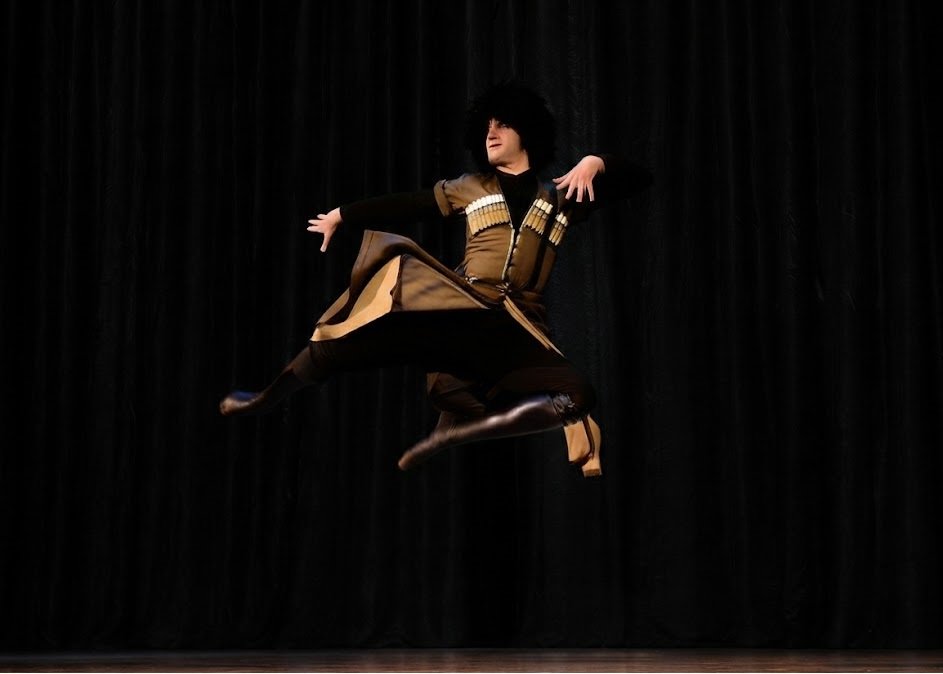
Georgian folk dance is the opposite of leisurely. The dancers whirl across the stage at breathtaking speed. You feel the passion as they perform their stylised sword fights, and admire the graceful elegance of the female dancers. Physical control plays a central role.
The men dance on their tiptoes – literally. Without pointe shoes, without any aid. Combined with death-defying leaps, lightning-fast spins and dramatic sword-fight choreography, the result is something that is hard to believe the first time you see it.
The women dance entirely differently – flowing, floating, with barely visible steps beneath long gowns. The respect and reverence that Georgian men show their women is clearly expressed in the dances. The woman in Georgian dance is the image of grace and dignity – the man the image of strength and courage. Together they tell a story without words.
Sukhishvili – The National Ballet of the World
The first state national ballet “Sukhishvili”, which today performs worldwide, was founded immediately after the Second World War and brings various regional dances to the stage.
Experiencing a Sukhishvili performance in Tbilisi is simply unforgettable. The combination of live music, perfectly rehearsed choreography and the emotional power of Georgian dance leaves no one unmoved. Tickets are affordable, but sell out quickly – if you are lucky enough to attend one of their shows, the impact is priceless.
