
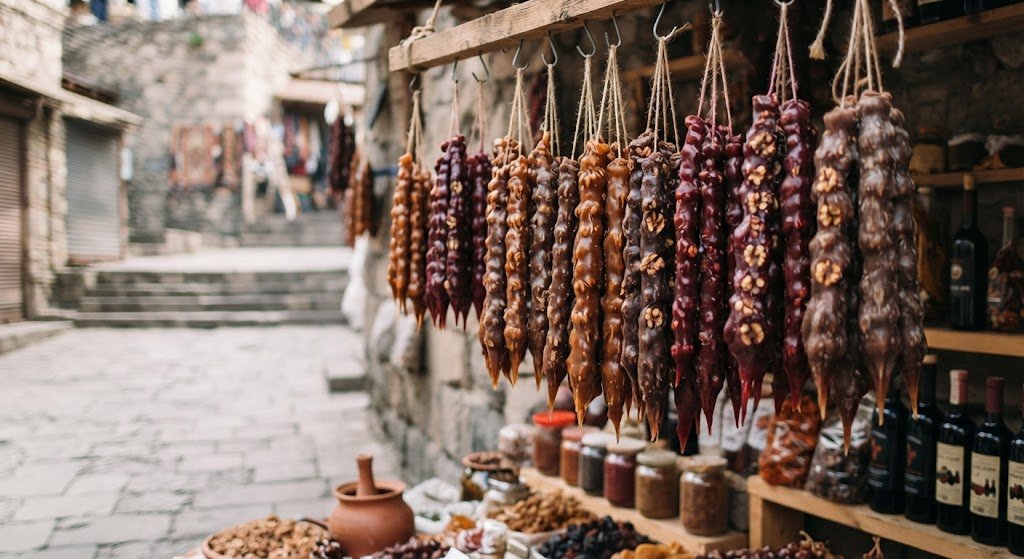
Churchkhela – Georgia’s Snickers
Some things, once seen, are never forgotten. Anyone visiting a Georgian market for the first time may not immediately recognise Churchkhela – a first glance suggests candles or lumpy sausages rather than a hanging mass of nuts. But that is exactly what Churchkhela is: walnuts or hazelnuts threaded onto a string, dipped again and again into thickened grape must enriched with flour, then hung out to dry for several days.
The result is a firm, candle-shaped sweet with a unique texture – slightly dry and waxy on the outside, soft and nutty within.
The traditional production of Churchkhela in the Kakheti region was inscribed on the Intangible Cultural Heritage of Georgia list in 2015. This is no coincidence: Kakheti is Georgia’s most important wine region, and Churchkhela is a direct child of winemaking – born from what is left over after the harvest.
Where to buy: Best found at the shop “Badagi”, all markets in Kakheti, and tourist shops in the old town – but ideally directly from a producer at the village market in Sighnaghi or Telavi. It is worth taking the time to find a good Churchkhela.
Tklapi – Georgian Fruit Leather
Tklapi looks like a thin, dried leaf – and is in reality a culinary masterpiece of preservation. It is made from a variety of fruits: wild plums, pears, mulberries, figs, apples, cherries. The fruit is cooked and pureed into a paste, then spread paper-thin onto wooden boards and dried in the sun.
The flavour is unfamiliar to Western palates – intensely sour, fruity, concentrated. But once you have taken a bite, you will not stop.
Gozinaki – Honey and Nuts for the Feast
Gozinaki is a crunchy confection of caramelised nuts – walnuts, almonds, hazelnuts – roasted in honey and traditionally cut into diamond shapes. Visually it resembles nougat or brittle, but the flavour is purer, more natural, deeper.
In Georgia, Gozinaki is prepared exclusively on New Year’s Eve and for the Georgian Christmas on 7 January. It is one of the few sweets that has remained deliberately tied to a festival – not a supermarket shelf, not a tourist shop, but the grandmother’s kitchen, the smell of warm honey, the crackle of crystallised nuts.
Those visiting Georgia at the right time – around 31 December or 7 January – will find Gozinaki in every household. Those who miss it must wait for the next winter. Or ask a Georgian friend if they have any left.
Nazuki – The Sweet Bread of Mtskheta
Mtskheta – Georgia’s ancient capital and a UNESCO World Heritage site. Those who stop there will smell it before they see it: Nazuki. A soft, sweet bread spiced with cinnamon, cloves and cardamom, studded with raisins and walnuts, baked fresh in the traditional clay oven (Tone).
Nazuki is not a dessert in the conventional sense – it is a bread that happens to be sweet. It suits breakfast, tea, a mountain hike. The bakers of Mtskheta often stand right by the road and sell it warm from the oven.
Chiri – Dried Fruit as an Art Form
Georgia has been drying fruit for centuries – not out of necessity, but out of tradition. Chiri refers to dried fruits threaded onto strings and hung in long garlands: figs, plums, apples, pears, dates, peaches – depending on the region and the season. You will find them at every Georgian market, hanging like strings of beads alongside the Churchkhela.
But Chiri is more than decoration. It is Georgia’s oldest fast food. Sweet, concentrated, long-lasting – perfect for travel, for winter, for working in the fields. Georgian grandmothers hang Chiri from their balconies every autumn, once the harvest is in. Two to three weeks later, the fruit is dry, sweet, and ready for the cold months ahead.
Particularly popular: fig Chiri – slightly sticky on the outside, soft and honeyed within. And plum Chiri – dark, intense, with a gentle tartness that recalls Tklapi but with a firmer, more satisfying bite.
